
Buy and Hold vs Rebalancing - What is better?
When it comes to building long-term wealth, investors often fall into two camps: those who prefer to buy and hold, and those who favour periodic rebalancing. The first strategy relies on patience and simplicity, the other on discipline and adaptability.
JioBlackRock advantage
·
Published on 20 May 2026
·
4 min read

What does buy and hold really mean?
Advantages of buy and hold:
- Simple to implement and follow.
- Shields you from short-term market noise.
- Minimises transaction costs.
However, buy and hold comes with hidden risks. Over time, outperforming or underperforming assets can skew your portfolio away from its original allocation. For example, a small-cap stock surge may make you overweight in equities. Or inflation might quietly erode the value of your investment in fixed deposits. These scenarios can expose you to more risk than you signed up for. If markets fall, the impact of this portfolio drift can be severe.
What is rebalancing?
Advantages of rebalancing:
- Maintains the portfolio in line with your risk tolerance.
- Prevents overexposure to any one asset class.
- Reduces portfolio volatility over time.
Ensures your portfolio remains on track to help meet your financial objectives.
Rebalancing can be done on a periodic basis say, quarterly or annually or in response to a trigger, such as when asset weights drift beyond a set threshold. Even indices like the NIFTY 50 rebalance every six months, replacing under performers with better performing stocks.
Case study: 2008 and 2020 market volatility
- Portfolio A: Buy-and-hold portfolio i.e. no rebalance (blue bars)
- Portfolio B: Portfolio rebalanced quarterly (orange bars)
During the 2008 global financial crisis:
- Portfolio A dropped 50% from its then high.
- By contrast, Portfolio B retained more value, dropping 42% from its then high.
During the 2020 Covid crash:
- Portfolio A fell by 30% from its immediate high.
- Portfolio B was more resilient and fell only by 23% from its immediate high
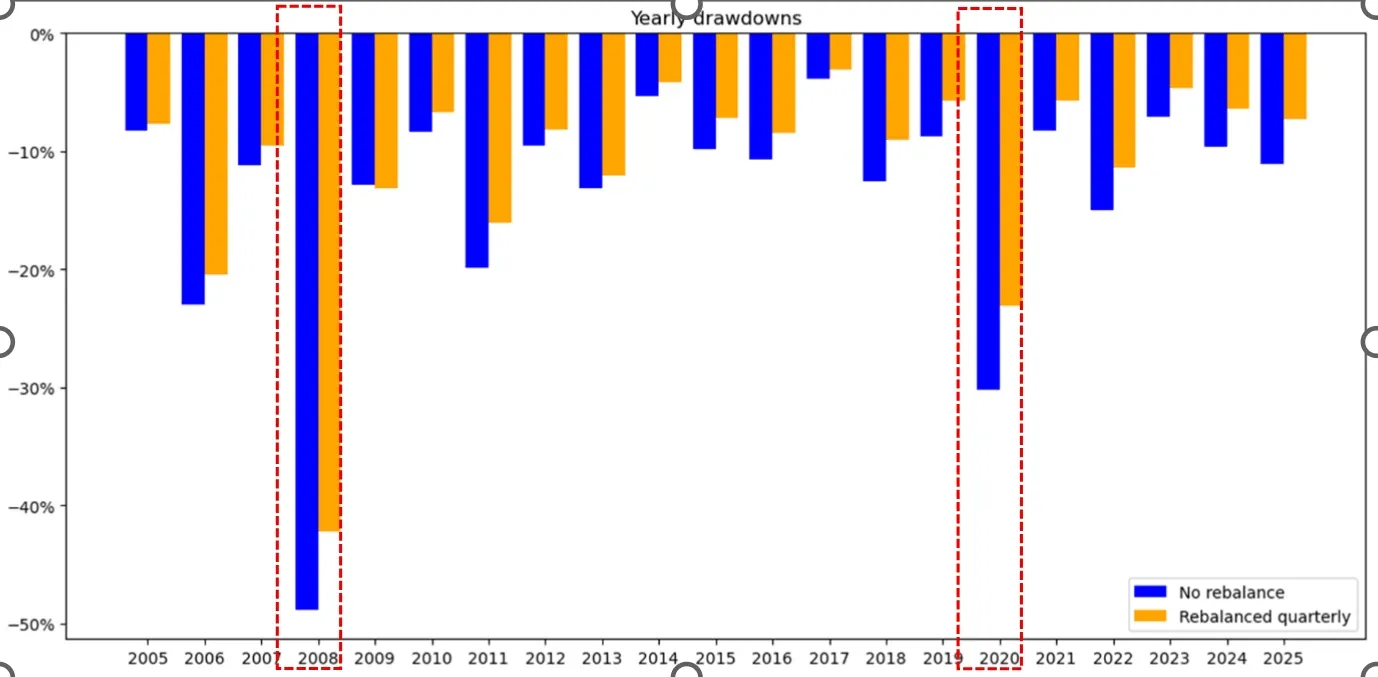
Source: Bloomberg. Data as of 30th June, 2025
For illustration purpose only
The above chart shows that most of the time, portfolios that are not periodically rebalanced lose more value than those that are during volatile periods. Rebalancing, therefore, provides a cushion against capital loss. It offers greater resilience and adaptability than buy and hold, especially during market movements, by protecting against drift and sharp downturns. If investors need to withdraw money during a volatile period, they would suffer more losses by withdrawing from un-rebalanced portfolios than rebalanced portfolios.
Key considerations when deciding your portfolio strategy
- Start by assessing your personal comfort level with market volatility by taking a risk profile assessment. If a 30% drop for instance would trigger panic-selling, buy and hold may not be suitable. In such cases, rebalancing provides a rules-based framework that helps maintain discipline and keeps you invested during turbulent times.
- For those in or about to enter retirement, prioritising rebalancing is also important for risk control. Allowing a portfolio to drift to, for example, 80-90% equity exposure just before or during retirement can have negative effects. For this group, a disciplined rebalancing strategy is recommended to preserve capital.
Bottom line: Investing isn’t just about growth, but about risk-adjusted growth
Questions you might have
This article is for educational purpose only.
Blogs
We want everyone to feel confident about investing and our learning hub is a good place to start – wherever you are on your journey.

Monthly Investment Outlook - September 2026
What’s shaping markets this September? The JioBlackRock Investment Team shares its monthly investment outlook for September 2026, explaining recent market sentiments and how portfolios are being positioned today. Explore our latest market views and asset allocation insights.

Monthly Investment Outlook - August 2026
What’s shaping markets this August? The JioBlackRock Investment Team shares its monthly investment outlook for August 2026, explaining recent market sentiments and how portfolios are being positioned today. Explore our latest market views and asset allocation insights.

Monthly Investment Outlook - July 2026
What’s shaping markets this July? The JioBlackRock Investment Team shares its monthly investment outlook for July 2026, explaining recent market sentiments and how portfolios are being positioned today. Explore our latest market views and asset allocation insights.

Monthly Investment Outlook - June 2026
What’s shaping markets this June? The JioBlackRock Investment Team shares its monthly investment outlook for June 2026, discussing the recent market pullback, the impact of geopolitical developments and oil prices on investor sentiment, and our latest asset allocation views. Explore our perspectives on markets, the economy, and opportunities across equities and fixed income.

Why is asset allocation important during periods of market stress?
Equities fuel growth, fixed income provides stability, and gold offers downside protection in uncertain times. Each asset class performs differently under varying market conditions, so what does this mean for you? Read to know….

How to interpret returns: Making sense of investment numbers for you
In this article we’ll break down the most common types of investment returns in simple language. By the end, you’ll know exactly what the numbers mean and how to use them.
