
Monthly Investment Outlook - October 2026
What’s shaping markets this October? The JioBlackRock Investment Team shares its monthly investment outlook for October 2026, explaining recent market sentiment and how portfolios are being positioned today. Explore our latest market views and asset allocation insights.
JioBlackRock advantage
·
Published on 15 October 2026
·
5 min read

Market Review
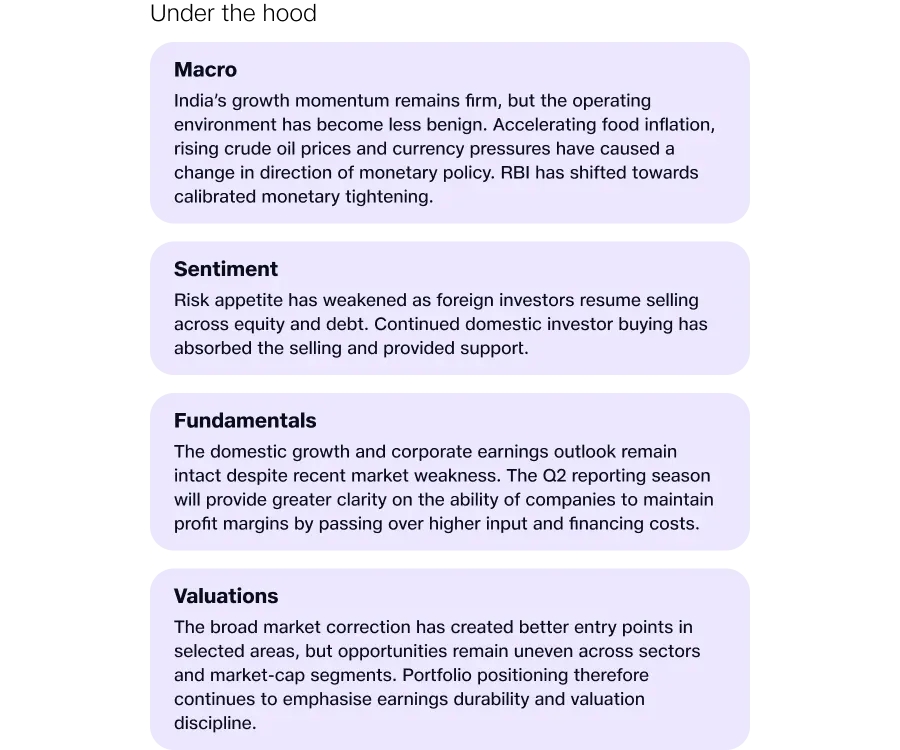
In fixed income markets, Indian government bond yields rose sharply. The benchmark 10-year government bond yield increased from around 7.0% to 7.4%, reflecting higher inflation expectations, tighter liquidity conditions and the change in monetary-policy direction. At its recent meeting, the Reserve Bank of India increased the repo rate by 25 basis points to 5.5% and shifted its stance from neutral to calibrated tightening.
Globally, financial conditions tightened as major central banks turned more hawkish and bond yields moved higher. The conflict in West Asia remained unresolved, disrupting energy supplies and pushing Brent crude back above USD 100 per barrel for much of the period. The combination of higher energy prices, elevated global yields and continued geopolitical uncertainty reduced risk appetite across emerging markets.
Inflation became an important macro concern. Headline inflation increased to 5.5% in September from 4.8% in August, while food inflation rose to 7.7% YoY. Rural inflation also increased to 6.1%. The combination of higher food prices, increase in core inflation and currency weakness led the RBI to raise its FY27 inflation forecast to 5.2%.
Investor flows remained sharply divided. Foreign portfolio investors withdrew approximately ₹35,900 crore from Indian equities in September, reversing the inflows recorded in July and August, with selling continuing into early October. Domestic institutional investors absorbed a substantial part of these outflows, with net purchases of approximately ₹92,700 crore in September, continuing to provide an important source of market stability.
The Q2 FY27 earnings season has only just begun. Early results indicate continued revenue growth but also place greater attention on margins and cost pressures. As reporting progresses, markets are likely to focus closely on companies’ ability to protect profitability amid higher commodity prices, borrowing costs and currency volatility.
Market Performance
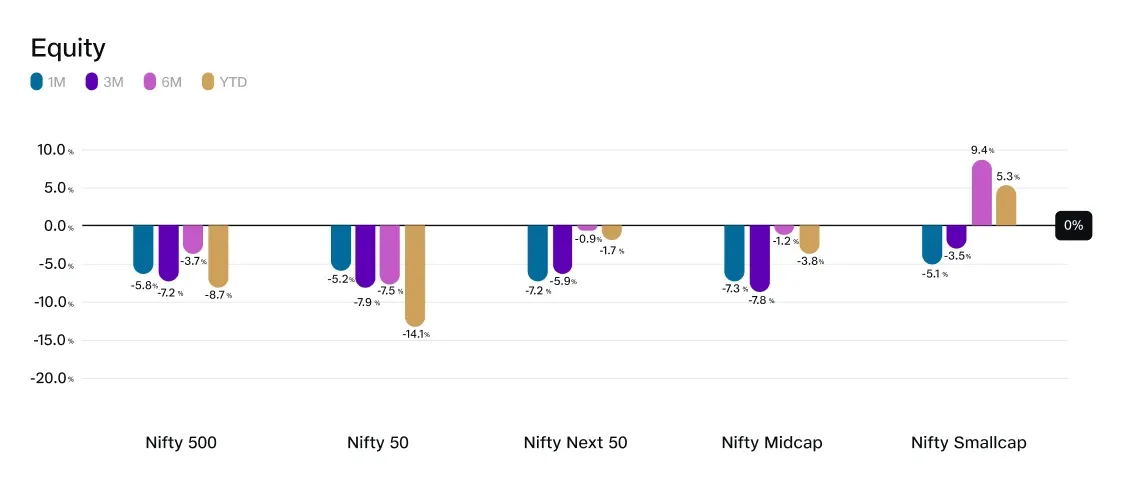
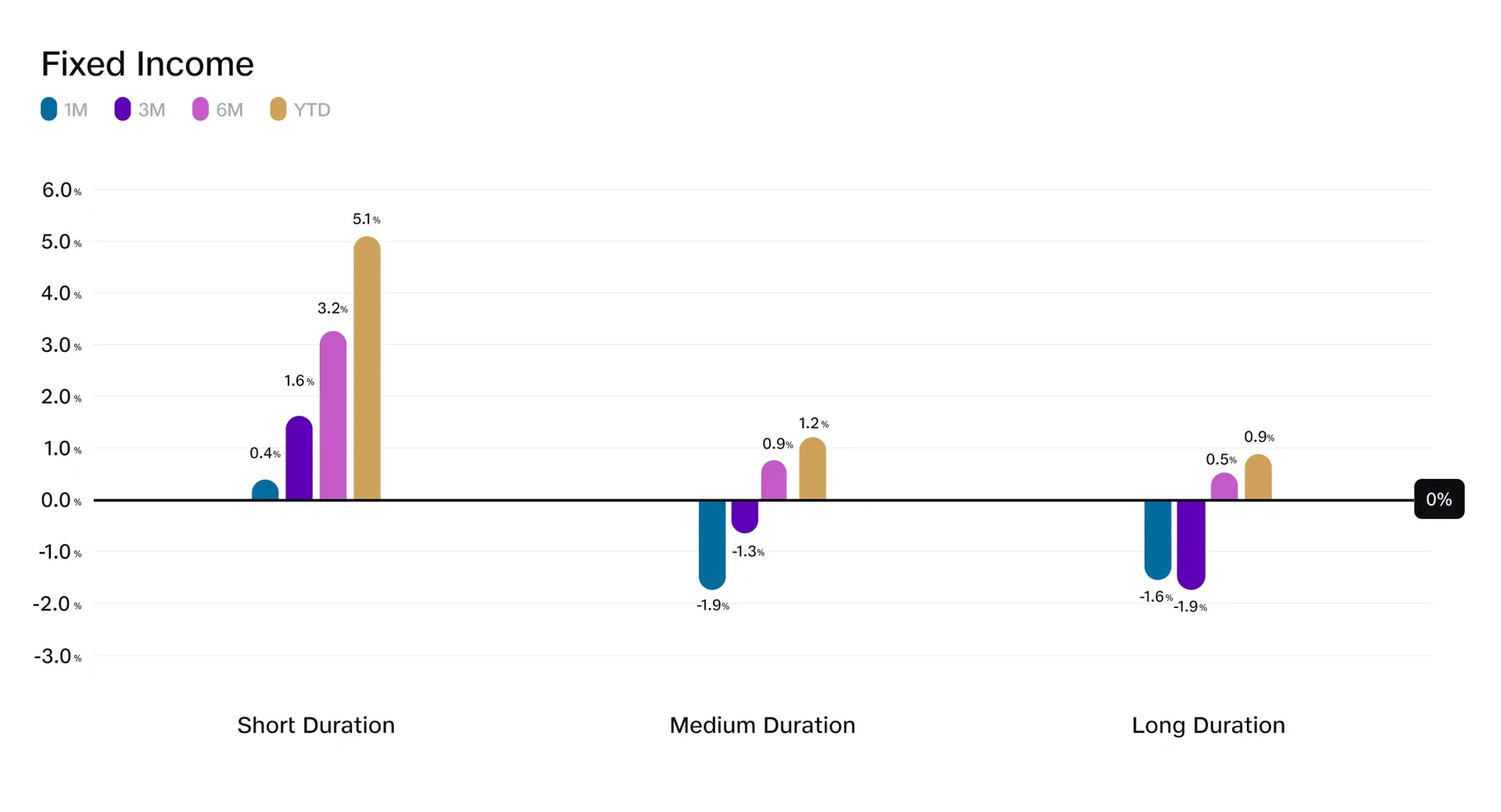
Source: Bloomberg,
Data: As of 9th October 2026
Asset Allocation View
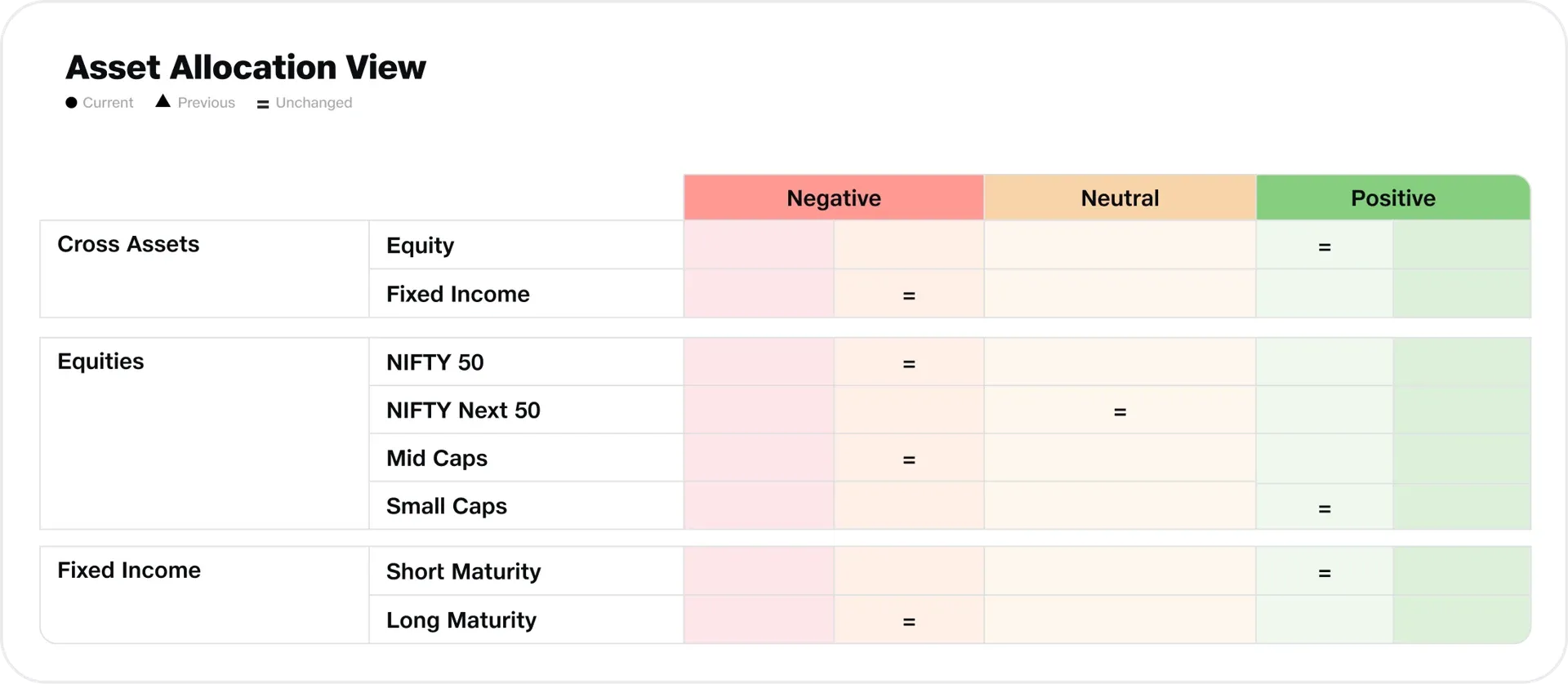
We remain constructive on Indian equities and continue to prefer equities over fixed income in our asset allocation. The recent correction reflects tighter financial conditions and resumption of foreign investor selling rather than a deterioration in domestic fundamentals. Resilient domestic growth and steady corporate earnings support our medium-term outlook. However, we remain highly focused on risks like elevated crude oil prices, higher inflation, tighter monetary policy, and geopolitical uncertainty. This warrants a measured approach to portfolios, and we are currently limiting the amount of risk we take in the portfolios.
Within equities, we continue to favor small-caps over large-caps. Smaller companies remain relatively well positioned to benefit from resilient domestic demand and the potential for stronger earnings growth. Mid-caps have outperformed over an extended period, reducing their relative valuation support, while large-cap earnings growth remains more moderate. Although small-cap valuations require careful selection, the recent correction has improved the relative risk-reward across parts of the segment.
Within fixed income, our preference for shorter-maturity investments continues. The rise in the benchmark 10-year government bond yield to around 7.4% has improved the value available in longer-maturity bonds. However, rising inflation, calibrated monetary tightening and elevated global yields continue to create uncertainty at the longer end of the curve. We therefore retain a cautious stance on longer maturity fixed income instruments while recognizing that the risk-reward has become more balanced at current yield levels.
Thank you for reading our October 2026 Investment Outlook. We look forward to sharing our latest market perspectives with you again next month.
Disclaimers
This Commentary is for limited distribution only and the recipient shall not copy/circulate/reproduce/quote contents of this document, in part or in whole, or in any other manner without prior and explicit approval of JBIAPL and treat the information contained in this Commentary with utmost confidentiality. The information is only for consumption by the client/recipient and such material should not be redistributed. If you are not the intended recipient, you are hereby notified that any use, distribution, reproduction, or any action taken or omitted to be taken in reliance of the same is strictly prohibited and may be unlawful.
This Commentary contains information, data, charts, and materials obtained from external and third-party sources ("Third-Party Information"). While JBIAPL believes such Third-Party Information to be reliable, JBIAPL has not independently verified such information and makes no representation or warranty as to its accuracy, completeness, or timeliness. JBIAPL assumes no liability for any errors, omissions, or inaccuracies in such Third-Party Information.
This Commentary is provided "as is" for informational and discussion purposes only. JBIAPL makes no representation or warranties, express or implied, regarding:
- The accuracy, completeness, or reliability of the information contained herein;
- The profile or data points of any underlying issuers, products or services;
- The suitability of any information for any particular purpose;
- Any outcomes or results that may be achieved.
Nothing in this Commentary constitutes legal, financial, investment, tax, professional advice or an investment advice, research report, or a recommendation or a solicitation to invest in any financial product or security or entity, or a promotion of any such financial product or security or entity, in any manner whatsoever or recommendation by JBIAPL of an investment strategy or whether or not to "buy", "sell" or "hold" an investment. The information available in this Commentary should not be considered as sufficient upon which to base an investment decision and is not based on consideration of the recipient's individual circumstances. Recipients should consult their own advisors before making any decisions based on information contained herein. This Commentary contains certain assumptions and views, which JBIAPL considers reasonable at this point in time, and which are subject to change. The views set out in this Commentary are indicative and are based on current market prices and general market sentiment.
All intellectual property rights in this Commentary, including but not limited to copyrights, trademarks, trade secrets, and proprietary information, remain the exclusive property of the JBIAPL or its licensors. No license or right is granted except as expressly stated herein.
To the fullest extent permitted by law, JBIAPL shall not be liable for any damages, losses, costs, or expenses arising from or relating to the use of, reliance upon, or inability to use the information contained in this Commentary.
Blogs
We want everyone to feel confident about investing and our learning hub is a good place to start – wherever you are on your journey.

Monthly Investment Outlook - September 2026
What’s shaping markets this September? The JioBlackRock Investment Team shares its monthly investment outlook for September 2026, explaining recent market sentiments and how portfolios are being positioned today. Explore our latest market views and asset allocation insights.

Monthly Investment Outlook - August 2026
What’s shaping markets this August? The JioBlackRock Investment Team shares its monthly investment outlook for August 2026, explaining recent market sentiments and how portfolios are being positioned today. Explore our latest market views and asset allocation insights.

Monthly Investment Outlook - July 2026
What’s shaping markets this July? The JioBlackRock Investment Team shares its monthly investment outlook for July 2026, explaining recent market sentiments and how portfolios are being positioned today. Explore our latest market views and asset allocation insights.

Monthly Investment Outlook - June 2026
What’s shaping markets this June? The JioBlackRock Investment Team shares its monthly investment outlook for June 2026, discussing the recent market pullback, the impact of geopolitical developments and oil prices on investor sentiment, and our latest asset allocation views. Explore our perspectives on markets, the economy, and opportunities across equities and fixed income.

Why is asset allocation important during periods of market stress?
Equities fuel growth, fixed income provides stability, and gold offers downside protection in uncertain times. Each asset class performs differently under varying market conditions, so what does this mean for you? Read to know….

Buy and Hold vs Rebalancing - What is better?
When it comes to building long-term wealth, investors often fall into two camps: those who prefer to buy and hold, and those who favour periodic rebalancing. The first strategy relies on patience and simplicity, the other on discipline and adaptability.
